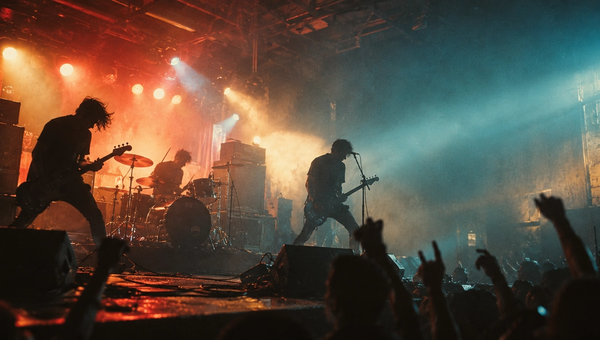

Beyond "Bodies": How Drowning Pool Refused to Stay Down
The song you already know
Drop the needle in a rock club, a stadium tailgate, or a military documentary from the last two decades and there's a good chance you'll hear four words: "Let the bodies hit the floor." "Bodies" outgrew its band almost immediately. It's a two-minute adrenaline shot that became shorthand for aggression itself, and it made Drowning Pool famous the year it landed. The single cracked the Top Ten on Billboard's Mainstream Rock chart, went platinum, and still gets the biggest roar of the night.
Here is the part most people miss: the hit is the least interesting thing about Drowning Pool. What makes this Dallas band worth your attention in 2026 is not one riff from 2001. It is the fact that they are still standing at all.
Dallas, 1996: a name pulled from a film reel
Drowning Pool formed in Dallas in 1996 and took their name from the 1975 Paul Newman film The Drowning Pool. From the start the band had a spine that never changed: guitarist C.J. Pierce, bassist Stevie Benton, and drummer Mike Luce. That trio is the whole reason this story has a throughline. Frontmen would come and go, sometimes under heartbreaking circumstances, but the engine room stayed bolted together.
They came up in the late-'90s Texas heavy scene and hit at the exact right moment, when nu-metal was tipping from underground churn into mainstream dominance. But calling them a pure nu-metal act undersells them. Drowning Pool always leaned heavier and more traditional than the genre's rap-inflected wing — closer to the muscle of alternative metal and radio-ready hard rock than to turntables and baggy jeans.
Sinner (2001): platinum in six weeks
The debut, Sinner, arrived June 5, 2001 and detonated. It debuted at No. 14 on the Billboard 200 and went platinum inside its first six weeks, a staggering pace for a debut. "Bodies" was the accelerant, but the record had legs beyond it, with a grip-you-by-the-collar production job and Dave Williams out front, all bark and swagger.
Williams had exactly the voice a band like this needed: enormous, unpretentious, built for a room full of people who wanted to scream along. Sinner remains the only studio album he ever finished. That is the hinge the entire band history turns on.
August 14, 2002: the loss that could have ended it
While touring in support of Sinner, Dave Williams died on August 14, 2002, of hypertrophic cardiomyopathy, a heart condition rather than the excess the road usually gets blamed for. He was in his early thirties. A band that had spent a year as one of hard rock's brightest new names suddenly had no voice, in every sense.
Plenty of groups do not survive that. The temptation to fold, or to become a nostalgia act frozen around a single record, would have been enormous. Instead Pierce, Benton, and Luce did the harder thing. They kept going, and in doing so turned Drowning Pool into something rare: a band defined not by a lineup but by a refusal to quit.
The revolving door years
What followed is the stretch that scares off casual fans and fascinates everyone else. Jason Jones stepped in and fronted 2004's Desensitized before departing in 2005. Then came the move that reshaped the band: they recruited Ryan McCombs, on loan from Chicago's SOiL, and for the first time broke their own pattern of swapping singers after every record. McCombs stuck around for two records, Full Circle (2007) and the self-titled Drowning Pool (2010). It was the band's first real taste of continuity since Williams. When McCombs left in 2011 to rejoin SOiL, Drowning Pool were, once again, looking for a frontman.
If you are keeping score, that is three different voices across four albums in under a decade. Most bands would read that as a death spiral. Drowning Pool treated it as weather.
The Moreno era: the longest calm
In 2012 Jasen Moreno took the microphone, and the band finally got the stability it had chased for a decade. Moreno fronted three albums — Resilience (2013), Hellelujah (2016), and Strike a Nerve (2022) — the most sustained run of any singer in the band's history not named Williams. This was Drowning Pool as a working, grinding, road-dog institution: not chasing the charts anymore, just showing up, putting out records, and playing to a loyal base that never needed radio's permission to care.
That decade is the real argument for Drowning Pool as survivors rather than a one-hit relic. Bands with a much smoother history burned out in half the time. Drowning Pool kept a catalog moving through three presidencies while cycling a frontman most fans could not have named on the first try — and the core three never blinked.
Full circle: McCombs comes home
Then the story did something stories rarely do. In March 2023, after twelve years away, Ryan McCombs rejoined Drowning Pool. The band that had spent its whole life moving forward through necessity finally got to circle back on purpose.
The reunion is not a legacy-tour cash-in. The reconstituted lineup — McCombs on vocals with Pierce, Benton, and Luce — released "REVOLUTION (The Final Amen)," their first new song with McCombs in thirteen years, and hit the road on the No Authority Tour in 2024. For a band whose narrative has so often been written in obituaries and lineup changes, a genuinely energized second McCombs era is the plot twist nobody had penciled in.
Why Drowning Pool still matters
It would be easy to file Drowning Pool under "that 'Bodies' band" and move on. Doing so misses the actual achievement. This is a group that lost its voice to tragedy, endured a revolving door that would have humiliated most acts, and came out the far side as a functioning, touring, recording band a quarter-century after it started — with three of its four founding members still in place.
That endurance is the whole point. Drowning Pool are proof that a band can be bigger than any single frontman. Their kind of hard rock longevity gets built in the rhythm section and the van, not the video, and at some point survival itself becomes the style. Their catalog is a map of the alternative metal scene's last twenty-five years, told through the one lineup stubborn enough to keep filling the microphone stand.
Track the current lineup, discography, and tour dates on Drowning Pool's page — and if you only know the one about the bodies and the floor, consider this your invitation to hear the rest.
Palances Liao is the founder of The Band Index, the rock, metal, and heavy-music discovery platform. Five years in the scene turned into building the tool it needed — band rankings driven by real engagement, a genre map that runs from hard rock through metalcore to deathcore, and festival lineups kept accurate and current. The result is an unusual vantage point: writing grounded not in one critic's taste, but in how the whole scene actually moves. Experience & credentials - 🎧 In rock & metal since 2021 (five years), as founder of The Band Index - 🏗️ Built and runs TBI's band rankings, genre hubs, and festival-lineup coverage - ✍️ Writes TBI's US heavy-festival recaps and the "what is [genre]" explainer series How I work: I only claim first-hand experience of festivals I actually attended; everything else is verified against primary sources and labeled. I follow TBI's Editorial & Sponsored Content Policy. Corrections: [email protected].