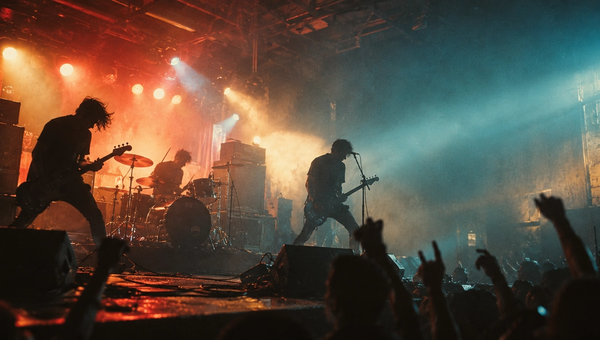

Alternative rock was never one sound, and that's still its strength
Alternative rock is the only major genre named after what it is not. There is no signature chord, no required tempo, no uniform. What holds it together is a stance: this is the stuff that did not fit whatever the radio was selling. That looseness looks like a weakness until you notice it is the reason the genre outlived nearly every trend that tried to replace it.
It started underground, on purpose
Pull up the Alternative Rock genre on TBI and the origin story is right there in the data: an American genre with roots in the 1970s, built on a punk-influenced, DIY production ethic. That is the important part. Alternative rock did not descend from arena rock. It grew out of the independent underground of the late 1970s, from bands who took punk's do-it-yourself attitude more seriously than its three-chord template.
In the United States, the early 1980s version of this got called college rock, because college radio was where it lived. Commercial stations would not touch it, so the network of student DJs, zines, and word of mouth did the work instead. In the UK, the same energy showed up as dozens of small do-it-yourself labels spinning out of the post-punk scene. Two countries, one habit: build your own distribution when the mainstream ignores you.
For most of the decade, "alternative" was less a sound than a filing cabinet. Noise pop went in one drawer, indie rock in another, then shoegaze, then the early rumble of grunge. None of them agreed on much sonically. What they shared was the position: outside.
The moment the industry admitted it existed
The tipping point has a date. With its September 10, 1988 issue, Billboard launched a dedicated chart to track this music on the radio, and the first song to top it was Siouxsie and the Banshees' "Peek-a-Boo" (Billboard). A trade magazine building a chart is a boring corporate act, but it meant something: the format had gotten too big to keep pretending it was a niche.

A few bands started crossing over. R.E.M. and Jane's Addiction signed to major labels while plenty of their peers stayed independent by choice. For a couple of years the genre lived in both worlds at once, half of it courting radio, half of it suspicious of anyone who did.
Then Nirvana ended the argument.
1991, and the changing of the guard
Nirvana released Nevermind in September 1991. On the Billboard 200 dated January 11, 1992, it hit number one and knocked Michael Jackson's Dangerous off the top (Billboard). Read that again. The King of Pop, at the height of his commercial machine, was displaced by three guys from the Pacific Northwest who had been on an indie label two years earlier.
The song that did it, "Smells Like Teen Spirit," was not built from scratch. Kurt Cobain said as much: in a 1994 Rolling Stone interview, he admitted he was "basically trying to rip off the Pixies," borrowing their soft-verse, loud-chorus dynamic and pushing it until it detonated (Far Out). That is the genre's whole method in one song. Take an underground idea most listeners never heard, sand off nothing, and let it land on the biggest possible stage.
Britpop did a parallel version of this in the UK, Oasis and Blur turning guitar bands back into tabloid front pages. By the mid-90s "alternative" had become, briefly and hilariously, the mainstream. Generation X was the audience, and the labels chased it hard.
The irony was not lost on anyone. A genre defined by being outside the mainstream had walked straight into the middle of it. Some bands leaned in; others treated a gold record as a problem to solve. That tension, between the underground reflex and the commercial reality, is baked into alternative rock's DNA, and it is why so many of its defining acts spent the back half of their careers trying to outrun the sound that made them. The genre never resolved the argument. It just kept moving.
Where the genre actually lives now
Here is where TBI's living data beats any encyclopedia entry. Sort the genre by popularity today and the top of the board is not who you would guess from a grunge documentary.
Coldplay sits at the top with a popularity of 90, Radiohead right behind at 88. Then Imagine Dragons and Arctic Monkeys tie at 87, with Twenty One Pilots and the Red Hot Chili Peppers at 85. Nirvana, the band most people would name first, ranks 83, level with a group most casual listeners would never file here at all: Deftones.
That leaderboard is the argument. Radiohead spent their career fleeing the guitar sound that made them famous. Twenty One Pilots barely touch a distorted guitar. Deftones came up through nu-metal and then, on White Pony in June 2000, pulled shoegaze, trip-hop, and post-rock into what was supposed to be heavy music (Wikipedia). None of these bands sound like each other. All of them are, correctly, alternative rock, because the label was never about a sound. It was about refusing to hold still.
The sound, such as it is
If you insist on sonic markers, TBI's genre traits give a fair working list: punk-influenced energy, DIY production, noise-pop texture, shoegaze haze, and grunge-style loud-quiet dynamics. Notice that these do not combine into a single recipe. A band can pick two and ignore the rest and still belong. Shoegaze buries the vocal under guitar; grunge shoves it to the front. Noise pop wants a hook under the fuzz; the DIY strain sometimes wants no hook at all.
The through-line is attitude toward polish. Alternative bands tend to treat studio gloss as suspect. Even Coldplay and Imagine Dragons, as clean as they get, carry a trace of it, the sense that the arrangement should serve a feeling rather than a formula. That instinct is the inheritance from the college-radio years, and it is why the genre keeps absorbing new sounds without losing its name.
Why it still matters
Genres usually die when their sound goes stale. Alternative rock cannot go stale because it was never pinned to one sound in the first place. The 2000s brought emo, garage-rock revival, post-punk and new-wave throwbacks, and the umbrella stretched to fit them all. That elasticity is why a chart Billboard invented in 1988 to corral a fringe format is still relevant, and why the genre page on TBI reads like a survey of most of what has mattered in guitar music for forty years.
Start anywhere on that top ten. Trace it back through Nirvana to the Pixies, back through the Pixies to the college stations, back to the first small labels pressing records nobody asked for. The line is unbroken, and it never once agreed on how it should sound. Every band on that list found its own way to be outside. That is not a bug in the genre. It is the entire point.
Palances Liao is the founder of The Band Index, the rock, metal, and heavy-music discovery platform. Five years in the scene turned into building the tool it needed — band rankings driven by real engagement, a genre map that runs from hard rock through metalcore to deathcore, and festival lineups kept accurate and current. The result is an unusual vantage point: writing grounded not in one critic's taste, but in how the whole scene actually moves. Experience & credentials - 🎧 In rock & metal since 2021 (five years), as founder of The Band Index - 🏗️ Built and runs TBI's band rankings, genre hubs, and festival-lineup coverage - ✍️ Writes TBI's US heavy-festival recaps and the "what is [genre]" explainer series How I work: I only claim first-hand experience of festivals I actually attended; everything else is verified against primary sources and labeled. I follow TBI's Editorial & Sponsored Content Policy. Corrections: [email protected].