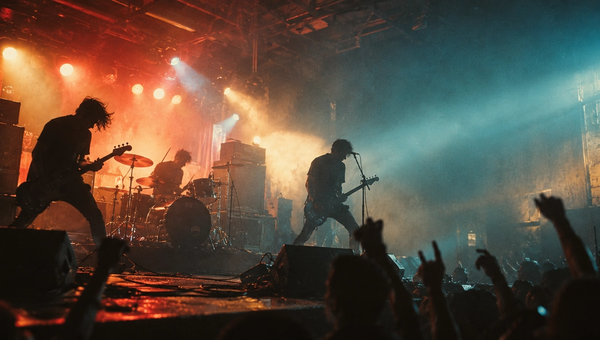

Hard rock isn't nostalgia. It's still the loudest room in music.
Every few years someone writes hard rock's obituary. The genre is too loud, too male, too tied up in denim and stadium lighting to survive whatever is trending. And every few years the obituary gets filed next to the last one, because the bands keep selling out the buildings.
Here is the thing the obituaries miss. Hard rock was never a single sound you could bury. It is a big, sweaty tent, and the tent is still full.
Where it actually comes from
Hard rock did not appear fully formed. It grew out of the electric blues of the 1950s, where players were already reaching for a rougher, nastier guitar tone and a declamatory, shouted vocal. By the mid-1960s the pieces had come together inside the garage, psychedelic, and blues-rock scenes on both sides of the Atlantic. The Kinks, the Who, the Yardbirds, the Rolling Stones, Cream, and the Jimi Hendrix Experience were all pushing volume and distortion past what pop radio was built for.
Then the floodgates opened. In the late 1960s you get Blue Cheer, Led Zeppelin, Deep Purple, Steppenwolf, and Free. Through the 1970s the genre becomes one of the biggest forces in popular music, with Black Sabbath, Alice Cooper, Aerosmith, Kiss, Queen, AC/DC, Thin Lizzy, and Van Halen all working the same core idea from different angles.
If you want the shorthand, the Hard Rock tag on The Band Index still points you to the quintessential examples: Led Zeppelin, Deep Purple, Black Sabbath. Blues-based rock, cranked up, with the amplifiers doing half the singing.
What it sounds like, mechanically
Strip away the mythology and hard rock is a pretty specific machine. Distorted electric guitar sits at the center, used two ways at once: as a rhythm instrument grinding out repetitive riffs, and as a lead voice for string-bending, blues-scale solos. The drums drive hard, leaning on the bass drum and a heavy backbeat on the snare, with cymbals for punctuation. The bass usually locks to the drums and holds the floor, occasionally stepping up to double a riff. Vocals growl, rasp, wail, or climb into a high register that sounds like it costs something to reach.
The unit of the whole thing is the riff. Not the solo, not the vocal, the riff. A great hard rock song hands you a guitar figure you can hum in the parking lot after one listen, and then it earns the next four minutes by hitting it from slightly different angles. Everything else, the drums, the bass, the wail, exists to frame that figure and hit it harder each time it comes back around.
That is the recipe. It is also where the endless argument with heavy metal lives. In the late 1960s the two terms were used interchangeably. They drifted apart over the following decade, and the split is more useful than most fans admit. Hard rock kept a bluesy rock-and-roll identity, some swing in the backbeat, riffs that outline the chord changes underneath the hook. Metal's riffs hardened into stand-alone melodies with the swing engineered out. Same volume, different physics.
The big tent, according to the data
Here is where The Band Index gets more interesting than a textbook. Look at who actually ranks as hard rock's most-followed acts in our data, and the neat little box falls apart.
Queen sits at the top, a band as comfortable with a piano ballad as a stomping riff. Right behind them is Metallica, who most people would file under metal without blinking. Then AC/DC, the purest distillation of the form, sharing space with Oasis, whose whole thing was Britpop swagger, not Marshall-stack menace. Keep scrolling and you hit Guns N' Roses, Bon Jovi, and My Chemical Romance inside a few slots of each other. An eyeliner-and-arena-emo band and a Jersey stadium-anthem machine, both flying the same flag.
You could call that messy. I would call it accurate. Hard rock as a lived category has always absorbed whatever hit hard and hooked fast. The glam-metal wave of the 1980s pulled in Mötley Crüe, Def Leppard, and Bon Jovi, then Guns N' Roses showed up with something rawer and buried the lot of them commercially. Later the door swung open for post-grunge, which is how you end up with Nickelback, a band people love to mock and stream anyway, sitting comfortably in the top ten of the same list as Led Zeppelin.

That range is the genre's actual identity. Not a sound frozen in 1974, but a gravitational pull. If a band is loud, riff-forward, and built to be heard from the back of a big room, hard rock claims it.
The part where it was supposed to die
The 1990s were the near-death experience. R&B, hip-hop, urban pop, grunge, and then Britpop ate hard rock's commercial lunch. The genre lost the center of the culture and did not get it back. For a stretch, being a hard rock band meant playing to your own crowd and ignoring the charts.
What the doom narrative gets wrong is that losing the mainstream is not the same as losing the audience. Post-grunge quietly adopted the hard rock template and sold millions. The established acts kept touring, kept selling catalog, and waited out the trend cycle that was supposed to bury them.
Where it stands now
Then there is the current tour ledger, which reads less like a wake and more like a victory lap. AC/DC rolled their Power Up tour through North American stadiums in 2025, their first full-scale trek across the region in nearly a decade, with The Pretty Reckless warming up the crowd. This is a band that formed in 1973 and has moved north of 200 million albums, still filling football stadiums fifty years on. Guns N' Roses have a stadium run of their own lined up. [VERIFY: 2026 dates and scope — https://www.hitsdailydouble.com/news/live/guns-n-roses-stadium-tour-2025-11-24] The demand is not nostalgic politeness. It is people who want to feel a bass drum in their chest.
Underneath the legacy acts, the soil is not empty either. A younger wave keeps circling back to hard rock's raw materials, from grunge revivalists digging into thick, fuzzy riffs to new acts pushing songs onto active rock radio. [VERIFY: e.g. Return to Dust as LA grunge revivalists and The Haunt's "Bad Omen" climbing rock radio — https://loudwire.com/new-rock-metal-bands-to-know-2026/] The specific names will keep changing. The appetite for a loud guitar and a chorus you can scream does not.
That is the honest state of hard rock. Not the biggest genre in the room anymore, and it does not need to be. It is the loudest, the most durable, and the one that keeps outliving its own funeral notices. Start with Queen or AC/DC if you want the blueprint, then follow the Hard Rock tag wherever it drags you. Half the fun is arguing about who belongs.
Palances Liao is the founder of The Band Index, the rock, metal, and heavy-music discovery platform. Five years in the scene turned into building the tool it needed — band rankings driven by real engagement, a genre map that runs from hard rock through metalcore to deathcore, and festival lineups kept accurate and current. The result is an unusual vantage point: writing grounded not in one critic's taste, but in how the whole scene actually moves. Experience & credentials - 🎧 In rock & metal since 2021 (five years), as founder of The Band Index - 🏗️ Built and runs TBI's band rankings, genre hubs, and festival-lineup coverage - ✍️ Writes TBI's US heavy-festival recaps and the "what is [genre]" explainer series How I work: I only claim first-hand experience of festivals I actually attended; everything else is verified against primary sources and labeled. I follow TBI's Editorial & Sponsored Content Policy. Corrections: [email protected].